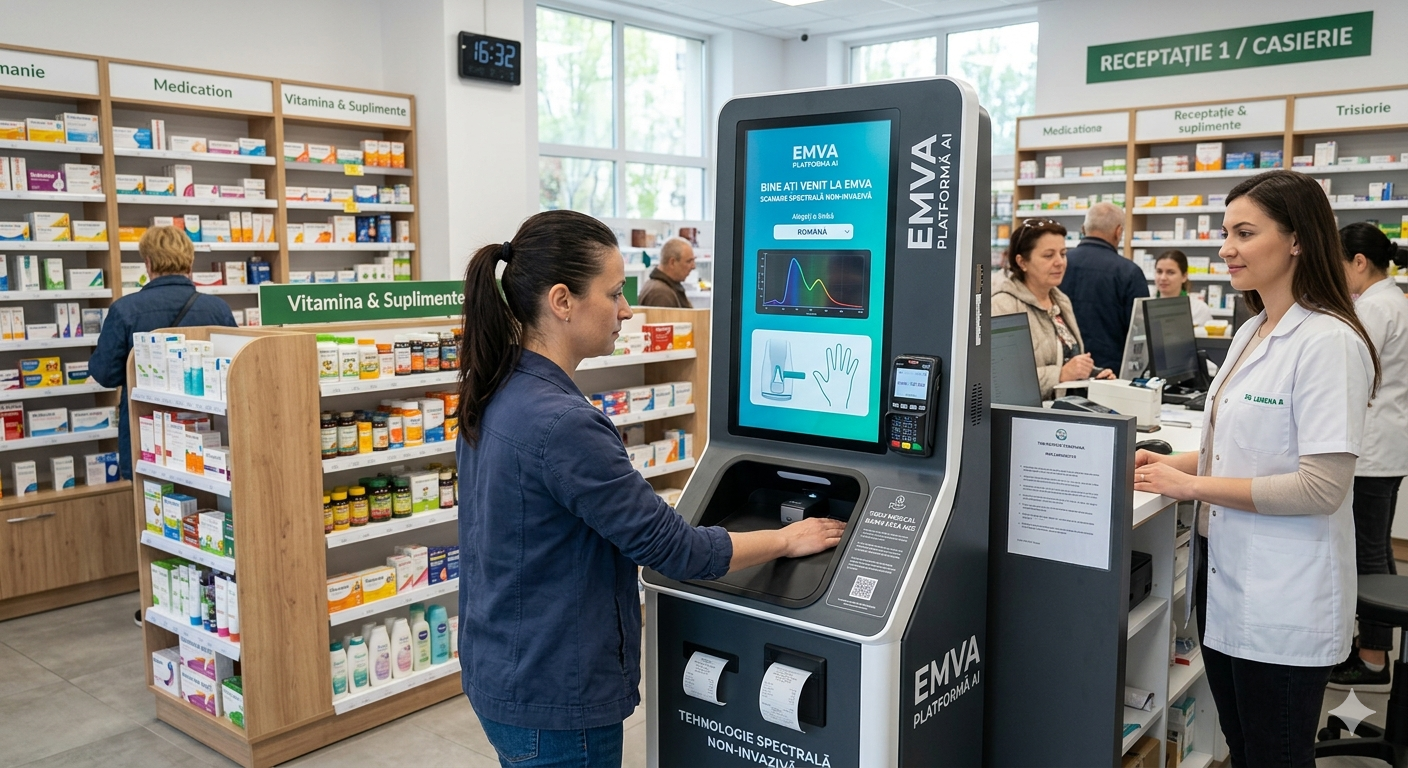
EMVA Skin: Your Optical Window to Health, in Just 10 Seconds
Have you ever wondered if your skin tells a deeper story about your body than just its outer shade? This is not magic—it is advanced bio-photonics.
The Romanian project EMVA Skin represents a breakthrough in medical prevention: we have successfully transformed a high-precision industrial spectrophotometer into an intelligent, non-invasive screening terminal, capable of reading biochemical indices from tissues in record time, without needles or pain.
How does it work? The science behind light
In essence, EMVA Skin directs a controlled beam of light onto the skin (standard measurements are taken on the inner forearm) and analyzes how that light is reflected back, covering the spectrum between 380 nm and 730 nm.
Every key molecule in our body has a unique “spectral identity card.” They absorb light differently, and our Data Science and Machine Learning algorithm translates these mathematical micro-variations into clear health indicators.
Seamless Preventive Screening in 3 Steps
1. Quick Health Profiling The user completes a brief, targeted questionnaire to establish essential baseline physiological and demographic context.
2. High-Resolution Optical Scan Using a portable, industrial-grade spectrophotometer, a non-invasive scan is performed directly on the user’s forearm to capture diffuse reflectance spectra across the 380 – 730 nm range.
3. AI-Powered Triage & Reporting Our cloud-based AI algorithm instantly analyzes the complex optical signatures of the dermal tissue. It maps general health vitality and flags subclinical anomalies or biochemical deviations, routing the user to a medical specialist for early, preventive intervention when necessary.
What can we read on the spectrogram? The 7 Key Indicators:
- Keratin Barrier (380 – 410 nm): We analyze the density and thickness of the upper stratum corneum to detect textural changes or reactive hyperkeratosis.
- Glycation Index / AGEs (420 – 440 nm): We monitor cellular aging and collagen stiffening caused by excess sugar, providing an early indicator for metabolic risk (prediabetes).
- Hepatic Toxemia / Bilirubin (450 – 480 nm): We scan for specific blue light absorption to detect metabolic waste or bilirubin accumulation, assessing liver stress before visible symptoms appear.
- Oxidative Stress / Lipofuscin (490 – 520 nm): We identify markers of cellular wear and tear generated by chronic fatigue, sleep deprivation, or free radicals.
- Blood Footprint and Oxygenation (540 – 580 nm): We track the famous “W” profile of oxyhemoglobin. The algorithm detects if peripheral tissue is suffering from hypoxia (lack of oxygen) or poor microcirculation.
- The “Sallow” Signature (650 – 730 nm): We evaluate the spectral slope in the red zone, a critical area that reveals the presence of low-grade systemic inflammation or burnout syndrome.
- Hydration Matrix (700 – 730 nm): We measure the behavior of free and bound water in the deep dermis, detecting acute dehydration states even when the subject feels adequately hydrated.
A Global Technology: No Algorithmic Discrimination
One of the greatest achievements of the EMVA Skin project is its universal calibration. Most artificial intelligence algorithms in current medicine suffer from massive “ethnic bias,” having been trained only on lighter skin types (Fitzpatrick Phototypes 1-3).
The EMVA database already includes complex, labeled profiles, ranging from Phototype 2 to rare regional cases of Phototype 6 (e.g., subjects from Nigeria). By applying mathematical transfer functions, the algorithm isolates the massive screening effect of dark melanin and succeeds in reading oxygenation and glycation with the same precision on any skin type on the planet.
The Future of Prevention: Triage in 60 Seconds
EMVA Skin does not replace classic laboratory tests; instead, it acts as a digital sentinel. It is the perfect triage tool for family doctor offices, pharmacies, or nutrition centers: a rapid optical scan that tells you exactly where your body shows signs of wear, indicating which specific blood tests you need to perform at the clinic. The project is based on Diffuse Reflectance Spectroscopy (DRS), a globally studied and recognized technology.
The project is registered in the Google for Startups program and is developed with a native cloud architecture, ready to bring non-invasive prevention to a global level.
Academic Partnerships and Clinical Validation
Currently, the EMVA Skin project is undergoing the necessary steps for scientific validation within the Faculty of Medicine at “Ovidius” University in Constanța. This academic collaboration represents a central pillar in our development, primarily aimed at rigorously confirming screening results through dedicated clinical studies.
Our Vision: Accessibility and Social Responsibility
We want EMVA Skin to become a benchmark project in social responsibility. Our long-term goal is to subsidize the costs of scanning so that every citizen can benefit from at least two preventive evaluations per year, directly contributing to increased quality of life and the level of prevention in the community.
Investments and Future Development
The EMVA Skin project is entering an expansion phase, and to achieve our proposed objectives, we are looking for partners and investors to support:
- Complex software development: Implementing an advanced platform for secure management and access to the clinical database.
- Equipping medical infrastructure: Facilitating access for clinics and family doctors to spectrometry technology to integrate this tool directly into current medical practice.
Through this investment phase, we aim to scale the EMVA Skin solution, transforming it from a research project into an accessible resource for the national medical system.
“Your body never lies in the face of light. EMVA Skin just learns how to listen to it.”
If you want to learn more about our studies, view the technical documentation archived on Zenodo, or schedule a scan, please leave a comment. We are seeking partnerships with medical institutions and specialists in Constanța for clinical validation and the expansion of the EMVA Skin database. To receive technical details, you must agree that further technical discussions will take place under a Non-Disclosure Agreement (NDA).
How does the EMVA Skin Project use innovation and technology to improve skincare solutions and address modern skin health challenges?
Thank you for your interest in the EMVA Skin Project and for reaching out from Telkom University!
To address your question, the EMVA Skin system is fundamentally designed as a non-invasive screening tool to assess general physiological health and systemic stress by measuring specific biomarkers directly through the skin, using 36-channel spectrophotometry.
While it can be integrated into advanced skincare or dermatological frameworks, its application in skincare is strictly limited to functioning as an objective, quantitative measurement instrument. EMVA Skin is highly effective where skin health challenges involve vascular changes (erythema) or pigmentary alterations (melanin).
1. Modern Skin Health Challenges & Specific Applications:
Inflammatory and Vascular Conditions: The system can accurately monitor conditions like rosacea, eczema, or contact dermatitis, where acute microvascular changes and erythema (redness) are primary indicators. By analyzing the optical absorption bands of hemoglobin, EMVA Skin can quantify the severity of the inflammation.
Pigmentary Disorders: It can be used to track melasma, post-inflammatory hyperpigmentation, or vitiligo by objectively measuring melanin density variations over time.
Treatment Response Tracking: One of its strongest use cases in skincare/dermatology is monitoring how a patient responds to a specific treatment (e.g., topical anti-inflammatory creams, laser therapies, or antioxidant regimens). It replaces subjective visual assessments with precise, repeatable spectral data.
2. Important Limitations (Not a Universal Tool):
It is crucial to note that EMVA Skin is not a universal diagnostic tool for all skin diseases.
No Skin Cancer Detection: The device cannot analyze cellular morphology or structural malignancy, meaning it cannot be used to detect skin cancers (such as melanoma or basal cell carcinoma). For these, traditional dermoscopy and biopsies remain irreplaceable.
Systemic vs. Topical: The system’s core innovation actually lies in reading the skin as a “window” to internal health—such as tracking advanced glycation end-products (AGEs), oxidative stress, and microcirculation drops related to burnout—rather than diagnosing structural skin diseases.
We believe that combining multi-channel spectral analysis with digital health tracking can significantly improve preventive medicine, offering an objective baseline for both systemic wellness and targeted skin health monitoring.